Limnology in one sentence
Anyone working with waters has to understand how everything is connected – animals, plants, chemical and physical factors. That is how PD Dr. Helga Zimmermann-Timm defines her profession when we visit her on site at the lake. It sounds simple, but it describes precisely the gap classical monitoring no longer fills today: point sampling delivers snapshots, not connections.
“A limnologist is someone who deals with waters – with the animals, the plants and all chemical and physical factors – and looks at how everything is connected.”
– PD Dr. Helga Zimmermann-Timm
The pressures have changed
In the 1970s, Germany's lakes faced a wave of problems. With remediation measures – ring sewerage systems, deep-water extraction, reduction of industrial wastewater – the situation was largely brought under control at the time. Today the pressure comes from different directions:
- Climate change. Waters are getting warmer. Higher temperatures mean higher metabolic rates – and higher risks of oxygen deficiency.
- Agriculture. While industrial wastewater is now largely regulated, diffuse inputs from agricultural land are the largest remaining problem.
- Floods and heavy rain. Extreme precipitation washes nutrients into waters – often in quantities the ecosystem cannot deal with in a single season.
- Sediment. A long-underestimated factor: when a water body becomes oxygen-poor, substances are released from the sediment that, in a healthy system, remain bound there.
“We face a series of challenges – the human factor, climate change, extreme rain events, storm events. The data shows that our waters are getting warmer.”
Local examples make this tangible. At Prinz-Emil-Garten in Darmstadt, heavy rain washes leaves from the surroundings into the water – they decompose and act as a nutrient source in spring. Which input source dominates varies from water body to water body. That is why diagnosis without data is impossible.
When a water body tips
More nutrients means more algal growth. Some algae are useful. Others – like blue-green algae – are a problem. They are inedible, often toxic, and thus a dead end in the food web. When they sink and decompose, they consume oxygen. In a warm season with already low oxygen levels, a chain reaction emerges: fish die, the sediment becomes active, and the water tips.
“At warm temperatures and low oxygen in the water, there is a danger that fish die – and that the entire water body tips.”
This is not just an ecological problem. A tipping water body emits about six times more greenhouse gases than a balanced one (DelSontro et al., 2018). A healthy lake binds carbon. A sick one releases it.
Which parameters really count
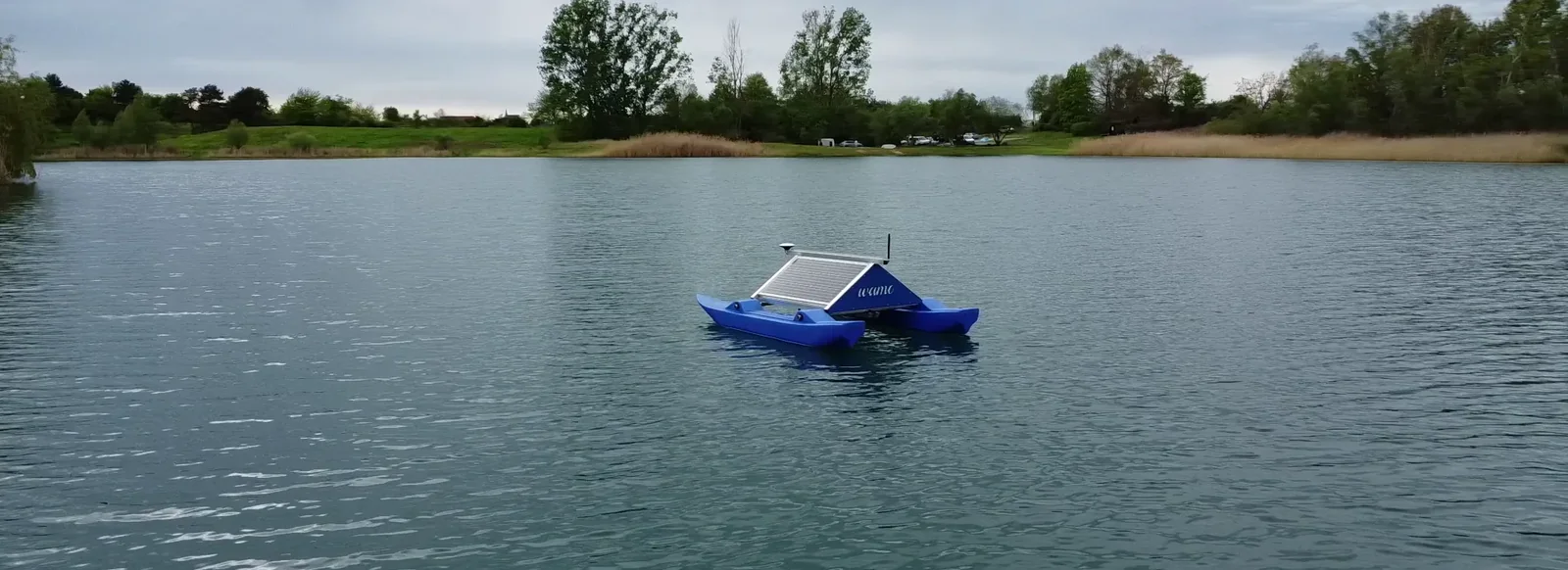
Asked which values should be measured continuously in a water body, a list emerges that we know – because our WAMO platform measures it:
| Parameter | What it shows |
|---|---|
| Oxygen | Indicator of stress, prerequisite for life in water |
| Secchi depth | Correlate of algal mass – the further you can see, the less production |
| Temperature | Driver of metabolism and algal growth |
| pH value | Shows algal activity and buffer capacity |
| Conductivity | Can indicate salt inputs or evaporation |
| Phosphorus | Most important nutrient driver of eutrophication |
| Nitrogen | The second central nutrient parameter |
“Having continuity is important – water biologists normally only come out at certain time intervals.”
This sentence is the core. Classical limnological monitoring delivers high-quality but point-in-time data. A continuous sensor platform does not replace it but complements it – and fills the gap between samples with what actually happens between visits: nighttime oxygen lows, sudden phosphorus peaks after heavy rain, gradual turbidity trends.
What makes a healthy water body
“Sufficient oxygen, good visibility, surrounding vegetation that fits the water body, and a habitat for the animals that belong there.”
That is how she describes a healthy water body. It is not a technocratic definition – it is one that anyone who has ever stood by a clear lake understands. And it is exactly the picture e.Ray's measures work towards: not as a one-shot intervention, but as continuously monitored, data-driven management.
What she also mentions, almost in passing: invasive species like Egyptian geese contribute considerably to nutrient inputs – especially where people feed them. A detail that does not appear directly in any sensor time series, but completes the picture: a healthy water body is always a water body in its surroundings.
“You can't manage what you can't measure”
The older generation of remediation measures had the luck of working with coarser tools – the problems were more concentrated and more localised. The new generation of pressures is diffuse, climate-driven and event-oriented. To understand them, you need data that shows what happened between Wednesday morning and Sunday evening, not only what arrived in the jar at the half-yearly sampling.
That is exactly why WAMO exists. And why we look forward to continuing the work together.
“We stay on board together and dive deep.”
– Sebastian Lemke
Baseline study for your water body?
We assess condition, budget and timeframe free of charge – and tell you honestly whether continuous monitoring is the right lever for your situation.
Request consulting →