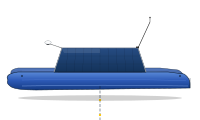

Vertical profiles down to 100 m
A motorised winch with depth encoder moves the counterweighted probe package through the entire water column. Depth levels, profiling cycles and hold points are freely programmable.
Where the compact WAMO 220 is anchored on surface waters, the 600 covers deep standing waters down to 100 m: in-situ measurement and automatic sampling from the same layer.
A motorised winch with depth encoder moves the counterweighted probe package through the entire water column. Depth levels, profiling cycles and hold points are freely programmable.
Thermocline dynamics, oxygen in the hypolimnion and phosphorus release from the sediment: the processes that determine how drinking-water dam reservoirs and impoundments are managed are captured at high resolution.
The integrated sampler draws depth-controlled grab samples from exactly the water layer in which the probe measures. Probe readings can thus be verified against official laboratory analysis.
Configurable for phosphate (PO₄) including its vertical release from the sediment, optionally ammonium, nitrate and further nutrient parameters. Chlorophyll and phycocyanin profiles as the basis for early warning of algal blooms.
Integrated camera for image-based turbidity determination, optionally an inline holographic microscope from Holodetect for detecting particles and microorganisms. Automated sensor cleaning reduces the maintenance effort.
2 × 300 Wp PV modules and a 100 Ah buffer battery for year-round operation, telemetry for module status and state of charge. Blackout-resilient GNSS water-level measurement without shore infrastructure or reference point.
At what depth the thermocline lies, how oxygen declines towards the bottom and whether phosphorus is being released from the sediment. Depth levels, cycles and hold points are set by the operator.
The grab sample comes from the same layer and the same hour as the probe reading. The laboratory confirms what the probe reports: the bridge between continuous sensing and official laboratory analysis.
Excerpt from the current data sheet. Configuration options and adaptations on request.
| Platform | Catamaran hull, approx. 2.5 × 2.0 × 1.5 m · total weight approx. 150 kg (depending on configuration) · low ecological impact, location-flexible installation |
|---|---|
| Probe lift | Motorised winch with depth encoder · profiling depth down to 100 m · freely programmable depth levels and measurement cycles · counterweighted probe package for stable vertical alignment |
| Probes and parameters | Compatible with probes from s::can, Endress+Hauser and bbe moldaenke · temperature, oxygen, conductivity, pH, turbidity, chlorophyll-a, phycocyanin, nitrate, DOC, UV254, spectral fingerprints · ammonium and further nutrient parameters optional |
| Sampling and optics | Integrated automatic sampler for depth-controlled grab samples · camera for image-based turbidity determination · optional inline holographic microscope (Holodetect) · automated sensor cleaning |
| Power supply | 2 × 300 Wp PV modules (600 Wp in total) · 100 Ah buffer battery for year-round self-sufficient operation · telemetry: module status, voltage, current, state of charge |
| Data acquisition and communication | On-board data logger 8 GB · Wi-Fi and GSM/LTE · Modbus and SDI-12 for sensor integration · optional connection to SWIM |
| Navigation and water level | Dual GNSS (Galileo / GPS) for position and water level · blackout-resilient GNSS water-level measurement without shore infrastructure or reference point |
Surface waters: WAMO 220, 20× in Mecklenburg-Vorpommern. Dam reservoirs, deep lakes and drinking-water reservoirs with thermocline, hypolimnion and nutrient budget: WAMO 600, vertical profiles to 100 m, automatic sampling.

You have a specific monitoring task? We analyse your site, propose the right configuration and deliver pilot station and SWIM connection as a complete package.


