Augustus first, 19 more by spring 2025
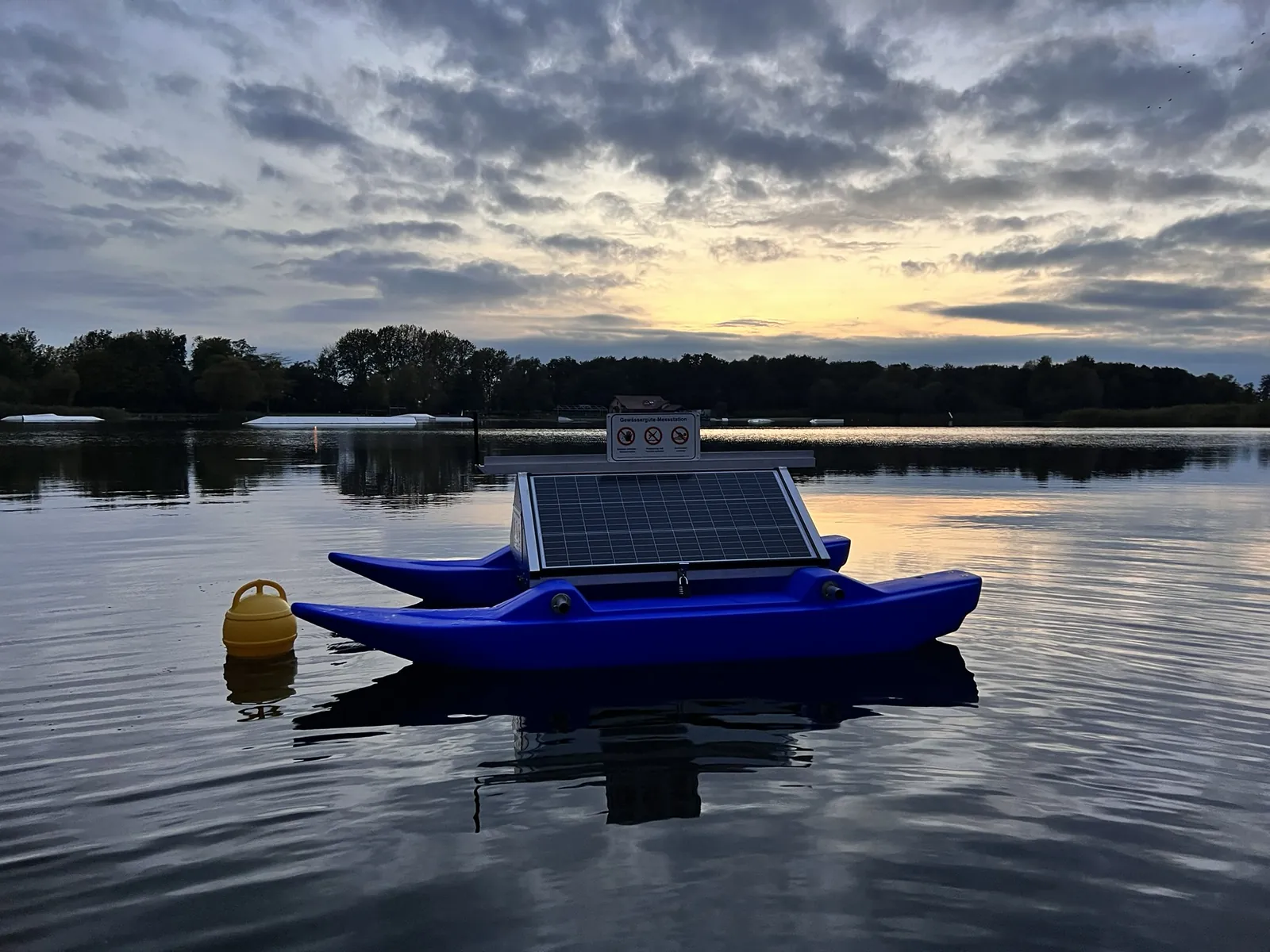
We christened the first station Augustus – a small gesture for a big undertaking. At the end of September 2024, a second station followed in Reitbahnsee, also in Neubrandenburg. The remaining 19 WAMO platforms will be deployed across further lakes of the Mecklenburg lake district and the Vorpommern-Greifswald district by spring 2025.
What such a station does: 24 hours a day, all year round, continuously capturing values – pH, oxygen, temperature, turbidity. Data flows directly to the responsible public health and environmental agencies, automated, without staff costs for each individual measurement. The sensors come from Badger Meter and s::can – market leaders we have integrated into our platform for years.
An undertaking of this scale is unique in Europe.
What meer.zukunft.seen actually is
The project is implemented by IKT-Ost AöR (an institution under public law) in Neubrandenburg and is one of 73 federally funded Smart City model projects in Germany. Funded by the German Federal Ministry for Housing, Urban Development and Building (BMWSB), meer.zukunft.seen aims to establish digital solutions in a region that belongs to Europe's most precious natural landscapes: more than 2,000 lakes, extensive river systems, connection to the Baltic Sea.
Alongside the WAMOs, the project also includes measures in the field of e-learning and digital infrastructure – the water stations are the ecological pillar. That a young Darmstadt company like ours delivers all the way to Neubrandenburg is, for us, still a moment of validation.
The problem we solve
Manual sampling for water-quality assessment at bathing sites is currently carried out every four to six weeks during the high season. During the cold season there is virtually no continuous monitoring. This data gap can lead to delayed diagnoses – and to the endangerment of bathers when algal blooms or critical oxygen levels build up between two samples.
With the WAMO stations, the relationship is reversed: data is available continuously. The agencies receive an early-warning system instead of a retrospective spot check.
“For waters, the same applies as for the human body: early diagnosis allows adequate prevention and therapy.”
This metaphor runs through our conversations with municipalities – because it is true. Anyone who has to treat a tipping lake comes too late. Anyone who sees the trend has options.
What the region gains
The Mecklenburg lake district and Vorpommern-Greifswald are tourist destinations for water sports enthusiasts, paddlers, nature lovers. Clean water is not only an ecological value but an economic one. When water quality is publicly visible – hour by hour, all year round – that creates trust. For locals planning their favourite bathing lake. For tourists wanting to know whether it is safe. For authorities that act in advance instead of in reaction.
Sebastian Lemke, our founder and CEO, sums it up like this:
“Only a magnificent and beautiful lake landscape, monitored with state-of-the-art measurement technology and maintained with the most effective restoration measures, is a lake landscape ready for the demands of the future.”
What is next
The 19 further stations will go into operation by spring 2025. In parallel, we are working with IKT-Ost AöR to consolidate the data into a shared situational picture for public health and environmental agencies – via the SWIM portal, our platform for satellite-supported and sensor-supported water intelligence.
What we learn in Mecklenburg flows back into our product development – and into the next regions with similar challenges. The Mecklenburg lake district shows that the digitalisation of water management in Germany is not theory. It is practice.
We look forward to Augustus II.
Similar undertaking in your region?
We will evaluate, free of charge, how continuous water monitoring can fit into a Smart City or tourism initiative. Get in touch.
Request consulting →