
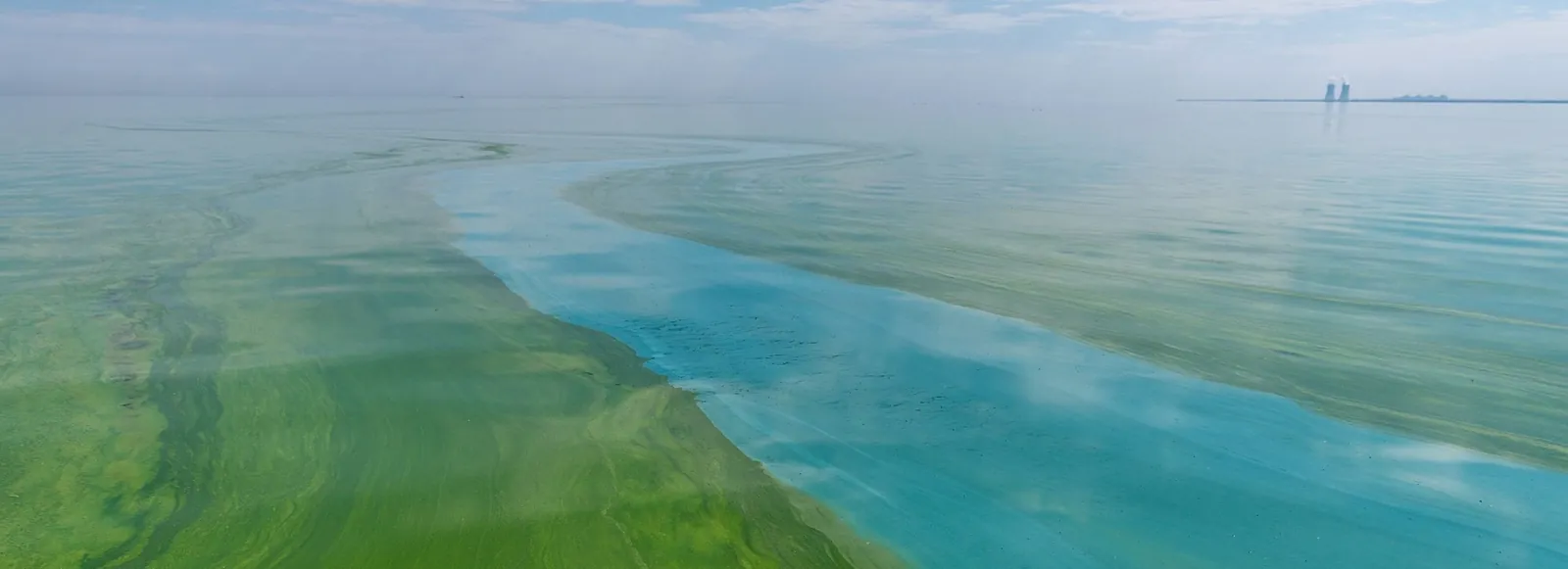
Welcome to the multifaceted world of blue-green algae. In this article we follow the trail of these microscopically small troublemakers and their effects on our environment – including humans and animals. A first fact upfront: blue-green algae are actually not algae at all, but bacteria. Their name comes from the blue-green pigment that some of them contain – hence the frequently used name cyanobacteria.1 Here is the overview of how these bacteria sometimes throw the balance of an entire planet out of order.
1. Cyanobacteria are the oldest life form on planet Earth
Cyanobacteria are the oldest known fossils on record. Findings suggest they first appeared on Earth about 3.5 billion years ago – and they still live in waters today. They are one of the largest and most important groups of bacteria on Earth. The basis of our life – the oxygen in our atmosphere – was likewise produced by cyanobacteria billions of years ago.2
2. The Azolla fern plunged Earth into an ice age 49 million years ago
At that time, the dramatic spread of Azolla brought a geological epoch to an end and produced the climate conditions we know today: frozen poles and tropical temperatures at the equator. The freshwater Azolla fern enters into a partnership with a cyanobacterium that supplies it with the necessary nitrogen and lets it double its biomass within two days using phosphorus inputs from land. As they died over the Arctic Ocean, the plants sank to the seabed and were preserved there – the stored carbon never made it back to the atmosphere. CO₂ concentration was halved at the time.3
3. Blue-green algae are responsible for hundreds of dead marine animals
In the summer of 2023, attention turned to a disaster in North America: hundreds of dolphins and sea lions in California washed up dead or sick due to toxic algal contamination. In Santa Barbara and Ventura, volunteers counted more than 100 dead sea lions. They also observed 300 sea lions showing signs of having ingested the neurotoxin domoic acid.5
4. Blue-green algae keep growing even when nutrients run low
Even when their food source in the water is already used up, blue-green algae do not just persist – some keep growing. The reason: these bacteria have found ways to store nutrients in the water. Some grow quickly, absorb large amounts of nutrients in a short time and starve other organisms; others grow slowly while building up reserves so they can also survive in nutrient-poor water. They thus stay dominant and crowd out other species.6
5. The global area of coastal blue-green algae blooms is more than 19 times the size of the Great Pacific Garbage Patch
A study published in Nature mapped daily algal blooms along 153 marine coasts from 2003 to 2020. At 123 of these coasts, blooms occurred whose extent and frequency increased significantly during the study period. The global area of these blooms came to around 30.5 million km²; the Great Pacific Garbage Patch is currently estimated at about 1.6 million km².7,8 Algal blooms in inland waters were not included at this resolution (1 km).
6. Blue-green algae cause considerable methane emissions in waters
In 2011 a research team detected an unusually high methane level near the surface of Lake Stechlin. Investigation showed that blue-green algae were producing the methane. While methane production is significantly higher during the day, the bacteria emit methane at night and in both oxygen-poor and oxygen-rich environments.9 As a greenhouse gas, methane is far more effective than carbon dioxide on a short horizon: within 20 years, its contribution to climate warming is more than 80 times that of CO₂.4
7. Blue-green algae are even toxic when inhaled
The most common routes of human exposure to cyanotoxins are direct contact, inhalation and ingestion.10 Depending on the strain, blue-green algae contain various toxic substances. The most toxic and most frequently detected toxin is microcystin-LR (MC-LR); it damages the liver, has negative effects on the male reproductive system and promotes liver tumours.11,12 Other toxins such as the neurotoxin anatoxin-a are lethal in higher doses within minutes to one hour – which is why dogs in particular face mortal danger when bathing in waters affected by blue-green algae.13
8. In the USA, toxic algae led to more than 300 emergency-room visits in three years
A study by the Centers for Disease Control and Prevention (CDC) shows that harmful algal blooms led to 321 emergency-room visits between 2017 and 2019, causing neurological, respiratory, gastrointestinal and skin problems. The actual number of those affected is likely higher, as the study only covered 70% of nationwide ER visits.14
9. Cyanobacteria are used as natural fertiliser in rice cultivation
Cyanobacteria are photosynthetic – they can produce their own food.2 Rice farmers exploit this ability: the bacteria enter into a symbiosis with the rice plant and supply it with nitrogen compounds from the air. Additional fertilisers become unnecessary.15
10. Blue-green algae can grow in the most inhospitable environments
At hot springs, in subglacial regions of cold lakes with ice depths of up to five metres and on the substrates of countless desert rocks, blue-green algae show remarkable adaptability. Some even grow in a mutual relationship with fungi, forming composite organisms – lichens.16
References
- Blaualgen: Wie gefährlich sind die Bakterien beim Baden? – NDR
- Introduction to the Cyanobacteria – UCMP Berkeley
- The Arctic Azolla event – The Geological Society
- Anthropogenic and Natural Radiative Forcing (p. 714) – IPCC AR5 WG1
- California toxic algae bloom kills or sickens hundreds of dolphins and sea lions – CNN
- Long and slow, or fast and furious – Phys.org
- Evidence that the Great Pacific Garbage Patch is rapidly accumulating plastic – Nature
- Coastal phytoplankton blooms expand and intensify in the 21st century – Nature
- Blue-green algae found to produce greenhouse gas methane – Phys.org
- Exposure to microcystin among coastal residents during a cyanobacteria bloom in Florida – ScienceDirect
- An overview of the toxic effect of MC-LR on testis – ScienceDirect
- New Records of Microcystins in Some Bulgarian Water Bodies – SCIRP
- Diagnosis of anatoxin-a poisoning in dogs from North America – PubMed
- Toxic algae exposure leads to more than 300 emergency room visits – EWG
- Cyanobakterien – Spektrum Lexikon
- Blue-green algae – Britannica
Suspect blue-green algae in your water body?
We continuously measure chlorophyll-a and phycocyanin – and see algal blooms days before they become visible. Get in touch.
Request consulting →